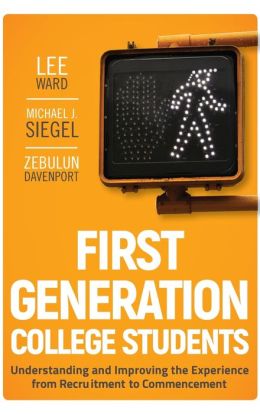
Monday, February 24, 2014

Literature Review #1

(1) Visual
 
(2) Citation            
  • Ward, Lee, Michael J. Siegel, and Zebulun Davenport. First-generation College  Students: Understanding and Improving the Experience from Recruitment to Commencement. San Francisco: Jossey-Bass, 2012. Print.

(3) Summary
  •  The book researches the challenges first-year students face and how to conquer them. It introduces the definition of a first-generation college student and follows their life through college. Also, it highlights class, cultural, racial, and ethnic differences of first-generation students.

(4) Author(s)
  • Lee Ward  Director of career and academic planning at James Madison University. He is knowledgeable about first-generation college students because he plans sustaining effective learning environments.
  • Michael J. Siegel  Associate professor and director of the administration of higher education program at Suffolk University. He is knowledgeable, as he has several publications about "campus culture" such as first college year, engagement, and learning
  •  Zebulun Davenport  Vice chancellor for student affairs at Indiana University-Purdue University Indianapolis. During his pursuit of an EdD, he focused on the retention of underrepresented students on campus. He is acquainted with the "environments, differences, and challenges minority students encounter."

(5) Key terms
  •  demographic characteristics- information that defines a population depending of factors varying from race to area of residence
  • self-efficacy-the individualized view of one's own ability to succeed

(6) Quotes
  • "...students whose parents did not attend are generally less prepared for the college experience than students whose parents attended college but did not necessarily receive a degree"(Ward 4).
  • "In addition to the enrollment patterns and deficit in parental support, where first-generation students attend college is of equal importance" (Ward 27).
  • "Navigating campus culture, understanding the language of the college campus, knowing the value of engagement, and having a catalog of educational coping skills passed down from one generation to the next are important ingredients in student success that are often lacking for first-generation students" (Ward 106).

(7) Value
  • The reading provides many great insights about first-generation students' challenges. It provides a good basis for me to research whether there really is a significant disadvantage. The book seems to tie in themes of individualization and effect of isolation on academic performance (it references Tinto). Also, the authors are well-acquainted with the subject. The book seems to be a very relevant source for my research.

Research Blog #3: Privatization

Privatization of college tuition creates financial obstacles for, specifically, low-income first-generation college students. They lack parental monetary and emotional support as they struggle with tuition bills.
As well, privatization of individual lives lead first generation students to set higher goals. They are extremely focused on going to college and obtaining a job. However, this individualization can have negative effects if they have certain characteristics [still to be researched] that hinder such success. For example, dependent on the college, it is common that first-generation students feel isolated and disconnected from colleagues. If they fall into the "social isolation" mentioned in Armstrong and Hamilton's study, their mental health, academic performance, and future success may weaken (Armstrong and Hamilton 111).

Monday, February 17, 2014

Research Blog #2: Scouting the Territory

My topic idea has changed since the first blog. I have acquired great interest in the college experience of first-generation college students. Do they have characteristics that deem them susceptible to poor performance or lack of academic integration? If yes, what are these characteristics? Does the fact that they are first-generation students make them any different than second+-generation students?
I think this topic suits me better than any of my previous topics because I can closely relate to first-generation students. I am a first-generation college student and am excited to explore the possible ways this circumstance affects education.
Through a quick online search, I found terms related to first-generation students such as cognitive/intellectual development, college experience, performance, characteristics, and engagement. There are also studies focused on the characteristics of first-generation students that dispose them to sub-performance in academic and social settings.
These articles seem useful for further reading:
  • First-generation college students: Characteristics, experiences, and cognitive development
    • [http://link.springer.com/article/10.1007/BF01680039]
  • First- and Second-Generation College Students: A Comparison of Their Engagement and Intellectual Development               
    • [http://www.jstor.org/stable/info/3838799]
Both of these articles provide arguments focused on first-generation students. The first article in particular follows a scientific study of thousands of first-generation students. There are controversial arguments that explain the ineffectual trait of being a first-generation. I hope to find some more arguments that have different perspectives/ideas.
Though I have not yet formed a direction for my research project, these studies should help me cultivate/frame some ideas.

Monday, February 10, 2014

Research Blog #1: Topic Idea


Social isolation in college: It would include a study of who is mostly happens to, why it occurs, and how it can be relieved. The subject is interesting, but I am still thinking how it can be sculpted into a viable research project.
Are exams effective?: Studies show that exams do not fully measure a student’s knowledge. Should we continue using standard exams to test students or implement a new method?
College pathways: the Armstrong and Hamilton study was really relevant to my college experience. I would study either the mobility or professional pathway.
Expectations of a college degree: why college?